
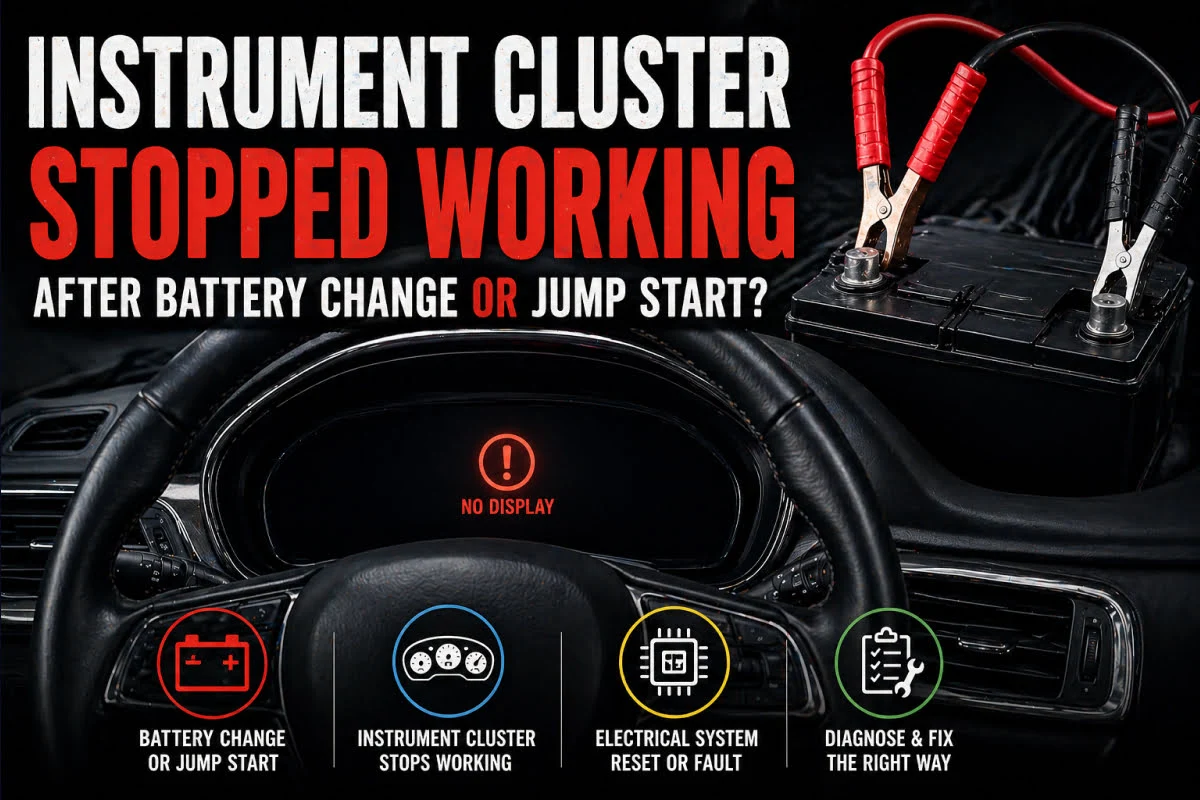
You changed your car battery or got a jump start, and suddenly your instrument cluster stopped working. The gauges are frozen, the speedometer reads zero, or the whole dashboard has gone completely blank. You are not alone. This is one of the most common and most confusing problems car owners face after a battery event, and it catches people completely off guard because the car itself starts and drives just fine.
The good news is that in many cases, this is fixable. The bad news is that some cases do require professional instrument cluster repair. This guide walks you through exactly what causes it and what to do first.
Modern vehicles rely heavily on stable electrical signals. Disconnecting, replacing, or jump-starting a battery can cause a sudden voltage surge. This spike travels through the wiring and can easily damage sensitive electronic components.
The instrument cluster is particularly vulnerable. It continuously communicates with the Body Control Module (BCM) and Engine Control Module (ECM) via the CAN bus network. A sudden power interruption or voltage spike can break this communication signal, blow an internal fuse, or cause a software lockup that stops the cluster from displaying data.
A blown fuse in the fuse panel connected to the instrument cluster circuit
BCM communication loss caused by the power interruption
A voltage spike from improperly connected jump cables (reversed polarity or sparking)
Loose or corroded battery terminals after the new battery was installed
A corrupted cluster module that needs a relearn or reflash via an OBD2 scanner
Do not ignore a dead instrument cluster and keep driving. Without a working speedometer and fuel gauge, you are operating a vehicle blind. It can also fail a state inspection or DOT check.
If you have checked every fuse, reset the battery, run a scan tool, and the instrument cluster is still not working after the battery change, the voltage spike likely caused internal hardware damage to the cluster circuit board itself. This is especially common when jump cables were connected with reversed polarity or when a high-amperage charger was used incorrectly.
In these cases, the cluster needs to either be professionally repaired or replaced with a matching unit. A repaired or replacement instrument cluster sourced from a specialist will restore full dashboard functionality, and in most cases costs far less than a dealer replacement. If you are not sure which route is right for your vehicle, check our instrument cluster FAQ page or request a custom order for hard-to-find models.
We carry over 50,000 used and refurbished instrument clusters for cars, trucks, SUVs, semi-trucks, tractors, and more. Ships across the USA and Canada.
Repair costs vary depending on the make, model, and extent of the damage. In most cases, professional instrument cluster repair is significantly cheaper than a dealer replacement. We offer free diagnostics and a quote within one business day.
Share:
We will try to give you an exact quote in 1 Business day


We will try to give you an exact quote in 1 Business day


